

Logo
1. Facials & Needling

1. Facials & Needling

Facials, peelings, microneedling with PDRN and exosomes, JetPeel and acne treatments.

View category
2. Tightening & Lifting

2. Tightening & Lifting

Radiofrequency, EMFACE and RF needling plus our signature combinations for firmer skin.

View category
3. Laser & Light

3. Laser & Light

Laser tuning, pico and CO2 laser, IPL and tattoo removal.

View category
4. Body

4. Body

EMSCULPT NEO and Cellution for muscle building, fat reduction and cellulite.

View category
5. Hair Removal

5. Hair Removal

Permanent laser hair removal for all areas – freely combinable, with 4- and 8-session packages.

View category
6. Medical Treatments

6. Medical Treatments

Dermatology, muscle relaxant, fillers, skin boosters, polynucleotides and medical laser treatments.

View category
7. Health Medicine

7. Health Medicine

General medicine, IHHT, infusions, NAD+ and longevity diagnostics.

View category

Laser tuning in Vienna – gentle skin rejuvenation with the erbium glass laser

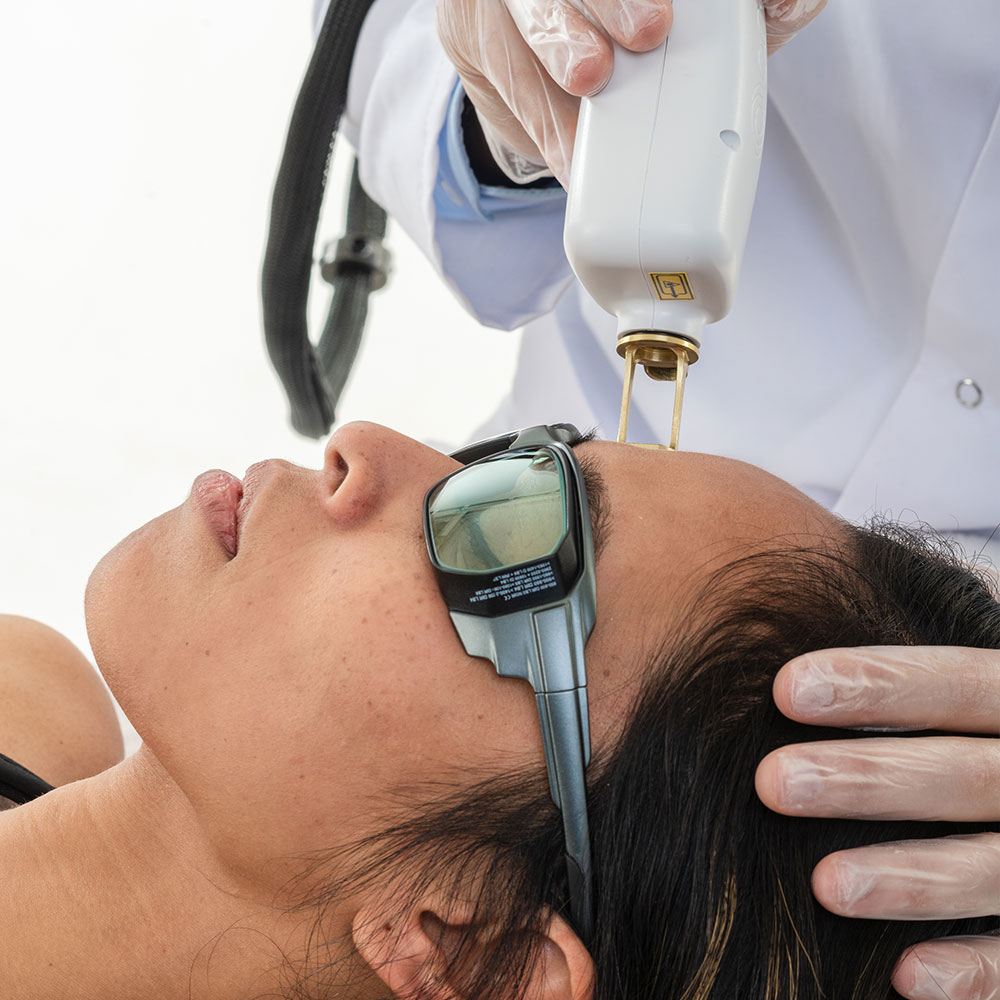
Laser results without laser downtime. Laser tuning works with a fractional erbium glass laser (1550 nm) that does not remove the skin but stimulates it to renew itself from deep within. Thousands of microfine heat columns set a controlled repair stimulus in the dermis while the skin surface remains intact. The result: finer pores, smoother texture, softer fine lines and an even glow – with one to two days of redness instead of two weeks of healing. The gentle alternative to the CO2 laser that can be repeated every month.


How does laser tuning work?

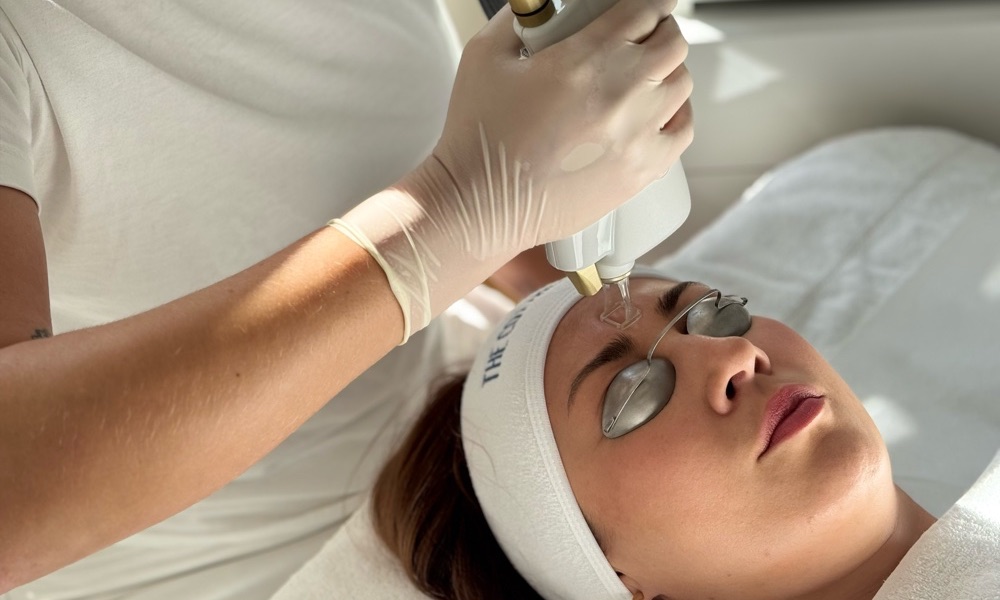
The erbium glass laser emits light with a wavelength of 1550 nanometers, which is absorbed by the water in the skin. The beam is fractional, i.e. divided into a grid of microscopically fine individual beams around 70 micrometers in diameter. Each of these beams creates a tiny coagulation column in the dermis – a zone in which the tissue is heated but not removed. Between the columns the skin remains untouched, and thanks to the fine beams and integrated cooling, the epidermis is almost completely spared.

These untreated tissue bridges are the reason for the short recovery time: from them, the skin repairs the micro-zones within a few days. At the same time, the stimulus triggers a remodeling process lasting several weeks – fibroblasts form new collagen and elastin, and old, disorganized tissue is replaced. Before the treatment, an anesthetic cream is left on for about 45 minutes. The treatment itself takes 20 to 40 minutes depending on the area; afterwards we cool the skin and apply soothing care.


How does laser tuning work?

At a glance

Icon

Technique

Fractional, non-ablative erbium glass laser (1550 nm) with contact cooling
Icon

Duration

20–40 minutes + 45 minutes anesthetic cream
Icon

Cost

from 220 euros
Icon

Downtime

1–2 days of redness and slight swelling, make-up from the following day
Icon

Pain

2–4 (scale 1–10) with anesthetic cream
Icon

Result

First glow after 1–2 weeks, collagen build-up from 4–6 weeks, best result 3 months after the third treatment

What you can expect from laser tuning

The non-ablative fractional laser has been established in dermatology since 2004 and is one of the best-researched procedures for skin rejuvenation. It does not replace a CO2 laser for deep wrinkles or pronounced sagging – instead, it delivers what most clients between 30 and 55 are actually looking for: visibly finer, more even and fresher skin without taking time off from everyday life.

What the treatment achieves:

  • Finer texture: The skin’s surface becomes more even, and small irregularities and rough patches are smoothed.
  • Smaller pores: Enlarged pores on the nose, cheeks and forehead look much smaller after a series.
  • Softer fine lines: Fine lines around the eyes, forehead and mouth soften, and crinkly lines on the décolleté become finer.
  • Smoother scars: Shallow acne scars, blemish marks and small scars become visibly flatter over several sessions.
  • More density: Collagen production makes the skin denser; it looks plumper and firmer – without volume from the outside.
  • Glow: The complexion becomes more even, and dull, tired skin regains its radiance.
  • Almost no downtime: No open wounds, no crusts, no peeling – you can go about your day as usual the next day.
  • Also in summer: Unlike the CO2 laser, laser tuning is possible all year round with consistent sun protection.

Laser tuning is particularly suitable:

  • for enlarged pores and uneven skin texture
  • for first fine lines and declining skin density
  • for shallow acne scars and blemish marks
  • for dull, sun-damaged or tired skin
  • for anyone who wants a laser treatment but not two weeks of downtime
  • as a regular “tuning” every month or quarter to maintain skin quality


Laser tuning or CO2 laser?

Both are fractional lasers, and both stimulate collagen. The difference lies in the wavelength and therefore in whether tissue is removed. The CO2 laser (10,600 nm) vaporizes microscopic columns of tissue including the epidermis – an ablative resurfacing with a correspondingly strong effect and correspondingly long healing. The erbium glass laser (1550 nm) only heats the columns and leaves the epidermis intact. It is less intensive, but repeatable, suitable for summer and for more skin types.

Laser tuning (erbium glass) Fractional CO2 laser
Mode of action Non-ablative: tissue is heated, the epidermis remains intact Ablative: tissue is vaporized, the epidermis is treated as well
Downtime 1–2 days of redness 7–14 days of crusting, redness and peeling
Pain 2–4 (scale 1–10) 3–8 (scale 1–10)
Sessions 3, 4 weeks apart, then maintenance 1–3, 4–6 weeks apart
Season Possible all year round Not in the summer months
Strengths Pores, texture, fine lines, shallow scars, glow, prevention Deep wrinkles, marked sagging, pronounced scars, eyelid tightening
Performed at Institute for medical cosmetics after medical clearance Medical practice
Price (face) €340 from €550
As a rule of thumb: if you want to refine and maintain your complexion, laser tuning is the right choice. If you need a significant correction of deep wrinkles or scars and can plan for healing time, the CO2 laser in our medical practice is the right choice. A combination often makes sense – a CO2 treatment in winter, laser tuning for maintenance throughout the year.

Learn more: Fractional CO2 Laser

Laser tuning compared with microneedling and IPL

Microneedling, IPL and laser tuning are often confused because all three "improve the complexion". However, they work towards different goals. Microneedling creates mechanical micro-channels and is particularly suitable for infusing active ingredients and for scars. IPL is not a laser but broadband light that removes pigment spots and redness – it hardly changes the texture. Laser tuning works thermally in the dermis and is the strongest of the three methods for texture, pores and skin density. In our signature combination, the Dual Collagen Protocol, we combine laser tuning with multipolar radiofrequency in one session: immediate tightening from the RF heat, lasting new collagen formation from the laser micro-zones.
Costs

Here you can find our complete price list: View price list

Series are personal and valid for 36 months. A short medical appointment for clearance is required before the first laser treatment; the Medical Cosmetics consultation (€60) is credited when you book a treatment within three months. All prices in euros incl. VAT.

Our tip: Laser tuning develops its effect through repetition. Three sessions four weeks apart build up the collagen structure; after that, one treatment per quarter is enough to maintain the result – hence the series with a 10% discount.


A Laser tuning

Fractional erbium glass laser for texture, pores & glow

Prices: Laser tuning
No.ItemSingle priceSeries / packageSeries price
A.1Laser tuning full faceMinimal downtime, monthly sessions possible340 €Series of 3 (–10 %)918 €
A.2Laser tuning partial areaFor example cheeks, forehead or eye area220 €Series of 3 (–10 %)594 €
A.3Neck or décolleté (add-on)Only together with full face, per zone160 €Add-on to the facial treatment–

See the full price list

Online Appointment

Laser tuning can be booked as a single treatment or as a series of 3 and can be combined with microneedling, medical peels or radiofrequency into an individual treatment plan. The first treatment takes place after medical clearance at the institute for medical cosmetics at our Vienna 1180 location.

Online Appointment

FAQs

Frequently asked questions about laser tuning

Fractional means that the laser beam is divided into a grid of many microscopic individual beams and treats only a fraction of the skin’s surface; the skin in between remains untouched and speeds up healing. Non-ablative means that no tissue is removed – the heat works beneath the intact epidermis. Together, these two features make the difference to the CO2 laser: the same principle, but without an open wound.

The CO2 laser removes microscopic columns of tissue including the epidermis and requires one to two weeks of healing. The erbium glass laser only heats the columns and spares the epidermis – the redness is gone after one to two days. In return, the effect per session is smaller; laser tuning works over three sessions and regular maintenance. For deep wrinkles or pronounced sagging, the CO2 laser remains the more effective choice.

With an anesthetic cream applied 45 minutes beforehand and the integrated cooling, most people experience the treatment as a warm prickling, around 2 to 4 on a scale of 1 to 10. The forehead and upper lip are more sensitive. Immediately afterwards the skin feels as it does after sunbathing; the feeling of warmth subsides within a few hours.

On the day of treatment the skin is red and slightly swollen, similar to a mild sunburn. On the second day it is often still a little pink and feels rough because the dot grid flakes off slightly. Make-up is possible from the following day. There are no crusts and no open areas.

To build up the effect, we recommend three sessions about four weeks apart. For acne scars, four to five sessions can be useful. After that, one treatment per quarter is enough for maintenance – hence the name laser tuning.

After one to two weeks the skin looks fresher and finer because the top layer has been renewed. The actual effect – new collagen, smaller pores, softer fine lines – builds up over six to twelve weeks and is most visible about three months after the last session.

Yes. Because the epidermis remains intact, the risk of pigment changes is considerably lower than with the CO2 laser. Two rules still apply: in the two weeks after the treatment, use sun protection with SPF 50+ every day and avoid direct sun, and we do not treat freshly tanned or sunburned skin.

Without restriction for light to medium skin types (Fitzpatrick I–IV). For darker skin types, the 1550 nm laser is generally safer than ablative procedures, but we then work with adjusted parameters and clarify this at the initial medical appointment. If you are prone to melasma, we decide individually.

We do not treat during pregnancy and breastfeeding, in the case of active skin infections or herpes in the treatment area, a fresh tan, a tendency to keloids, if isotretinoin has been taken in the last six months, or when taking photosensitizing medication. If you are prone to herpes, we recommend preventive prophylaxis – please mention this at your initial appointment.

Because every laser treatment requires medical clearance: skin type, previous illnesses, medication and tendency to pigmentation are checked and the treatment parameters are determined. The appointment is short and only needed once; afterwards you book your sessions directly at the institute.

Very well. Proven combinations are multipolar radiofrequency in the same session (Dual Collagen Protocol), microneedling with PDRN or exosomes as a regenerative follow-up treatment two weeks later, and alternating with IPL for pigment spots. After a CO2 laser, laser tuning is suitable for maintenance from about three months onwards.

Fraxel is one manufacturer’s brand name for non-ablative fractional lasers; the technology behind it uses the same 1550 nm wavelength that laser tuning works with. The difference lies in the device, beam diameter and treatment concept – laser tuning is designed for gentle, repeatable sessions with minimal downtime.